
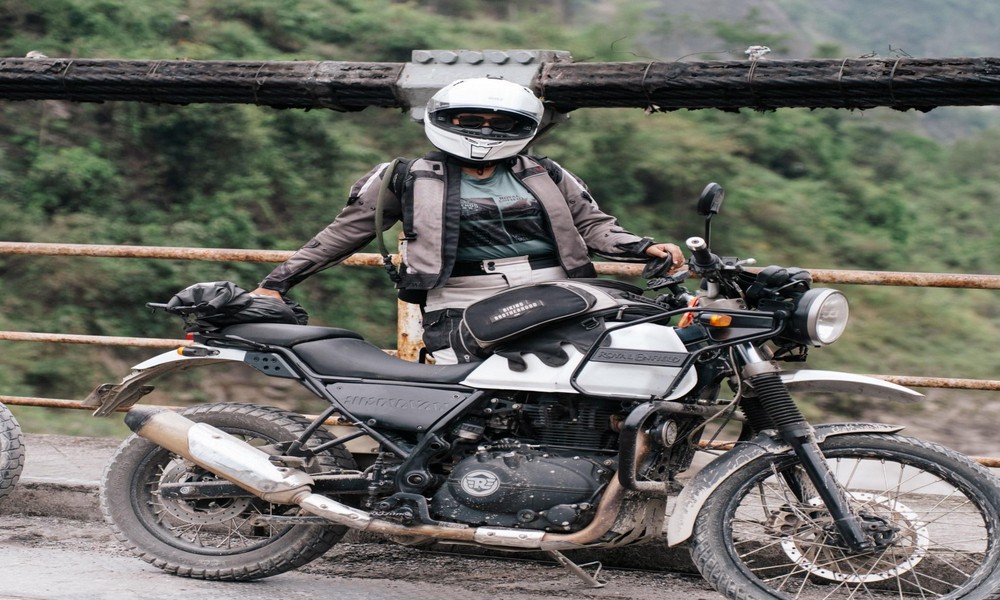
The question comes before almost every conversation about the trip. Not “which route did you take” or “what bike were you on”, those come later. The first question, almost without exception, is some version of: “Was it safe? As a woman, alone?”
It is a fair question. It also tends to flatten a much more complicated and interesting reality into a binary that does not capture what solo female motorcycle travel through Nepal’s remote valleys actually feels like from the inside. This article is an attempt to give that reality its proper texture: the genuine difficulties, the unexpected ease, the moments of vulnerability, and the moments of profound freedom that together make up the experience.
The Assumption Most People Bring – and Why It’s Partially Wrong
The assumption is that riding solo as a woman through remote Nepal is primarily a safety calculation. That the central question is threat management, and that everything else, the riding, the culture, the landscape, is secondary to getting through without incident.
This framing is not entirely wrong. Safety considerations are real and worth addressing directly. But leading with them exclusively misrepresents what the experience is actually like, because for the majority of the journey through Nepal’s remote valleys, the defining characteristic of solo female riding is not danger. It is visibility – a specific, often disarming kind of visibility that shapes every interaction in ways that are frequently surprising and occasionally deeply moving.
A solo woman on a motorcycle tour in Nepal is conspicuous. Not threatening, not problematic – conspicuous. You are noticed. You are remembered. Tea house owners recall you to the next rider who passes through. Local women approach you with a directness that group travel rarely generates. Children follow you with unashamed curiosity. The social texture of travelling solo as a woman through rural Nepal is different from travelling as a man, or as part of a group, and different does not mean worse. In many specific ways, it means richer.
What the Safety Picture Actually Looks Like
Honest reporting requires acknowledging the real risks without inflating or minimising them.
Nepal’s remote valley communities are, by the consistent experience of solo female riders who have travelled them, among the more respectful rural environments in Asia for women travelling alone. The cultural framework of Nepali and Tibetan Buddhist communities in the higher elevations – where many of the most compelling motorcycle routes run – includes a tradition of female autonomy and economic participation that translates into a social environment where a woman travelling independently is unusual but not transgressive.
This does not mean the experience is without uncomfortable moments. Unwanted attention occurs, particularly in lower-elevation towns and at fuel stops on the main highways between remote sections. The transition zones where rural community norms give way to transient male-dominated spaces like truck stops, fuel stations on the Prithvi Highway, and certain town guesthouses, require more vigilance than the remote valleys themselves.
The practical safety measures that solo female riders consistently recommend are unglamorous but effective: arrive at your overnight destination before dark without exception; book accommodation in advance where possible, or identify your options before arrival; trust the instinct that tells you a particular guesthouse or situation is wrong and act on it immediately rather than tolerating discomfort out of politeness. The riders who report the most difficulty are disproportionately those who pushed late into unknown areas after dark or ignored early signals of a situation that was not right.
The riders who report the most positive safety experiences share a different common factor: they built local relationships quickly, communicated their route and check-in schedule to people they trusted, and treated the communities they passed through with the genuine curiosity and respect that generates reciprocal goodwill.
The Tea House Network as a Safety Infrastructure
One of the least discussed advantages of Nepal’s specific travel infrastructure for solo female riders is the tea house network along established routes. Whether you’re on a motorbike tour to Upper Mustang or The Annapurna Circuit or the trails into Manang or the Langtang valley approaches, these routes are served by family-run tea houses where the owner often knows the owner of the next tea house up the road. Word travels faster than motorcycles on these routes.
Within a single day of riding, the tea house owner who served you breakfast has often already spoken to the one who will serve you dinner. Your presence, your bike, your rough plan – these are known ahead of you in a way that creates an informal but genuinely functional safety network. Women who have ridden Nepal’s tea house routes consistently describe feeling, after the first day, that they are travelling through a community that is aware of them rather than through an anonymous landscape where no one knows they exist.
This is not universal. It applies most strongly to established routes with consistent tea house density. Riders pushing into genuinely remote areas – Dolpo, the far western routes, the trails north of Humla – encounter longer gaps between human habitation where this network thins and the self-sufficiency requirement increases proportionally.
The Riding Itself: Where Gender Becomes Irrelevant
There is a specific quality of attention that technical motorcycle riding demands that temporarily suspends almost every other identity category. On a river crossing above Kagbeni, or on the loose switchbacks above Muktinath, the only relevant facts are the surface in front of you, the weight distribution of the bike, and the decision you are making in the next three seconds. Gender, nationality, age – none of it exists at that moment.
Solo female riders who have done Nepal’s remote routes frequently describe this aspect of the riding as unexpectedly liberating. The hours spent in pure technical engagement – present, focused, beyond the reach of social categories – accumulate into something that feels like a particular kind of freedom that is hard to access in ordinary life and that the specific demands of remote mountain riding provide more reliably than almost any other experience.
This is not unique to female riders. It is a quality of serious adventure riding that riders of all backgrounds describe. But it arrives with specific additional weight for women who spend a meaningful portion of ordinary life navigating spaces where their gender is the first thing noticed about them. On a difficult Nepal mountain track, it is the last.
What Local Women Make of You
This is the part that most travel writing about solo female adventure riding misses almost entirely, and it is among the most memorable dimensions of the experience for riders who have paid attention to it.
In the Tibetan Buddhist communities of upper Mustang and the Manang valley, women run significant portions of the economic and domestic life of the village. The female tea house owner who quotes you a fair price, manages the kitchen, supervises her children, and gives you accurate road condition information in the same five-minute conversation is not performing capable independence – she is simply living it. The interaction between a solo female rider and these women carries a quality of mutual recognition that is difficult to articulate and immediately palpable.
In the lower hill communities, the dynamic is different but equally interesting. Women who have never left their valley, who have lived within a radius of a few kilometres their entire lives, who marry young and carry enormous domestic and agricultural workloads – these women look at a solo female rider with an expression that experienced riders describe with remarkable consistency as a complicated mixture of curiosity, something resembling admiration, and occasionally something that looks like wistfulness. The conversation that follows, conducted through broken Nepali or a translation chain through younger community members, is frequently among the most honest exchanges the journey produces.
You are, in these moments, a data point that does not fit the category system of their experience. A woman, alone, on a motorcycle, choosing this. The fact of you requires some processing. What comes back, more often than not, is warmth.
The Honest Difficult Parts
Exhaustion hits differently when there is no one to share the cognitive load of decision-making. Route choices, mechanical concerns, accommodation decisions, weather judgment calls – every one of these lands entirely on you, every day, without the relief of a second opinion or the simple comfort of saying out loud to another person “I’m not sure about this.” The psychological weight of sustained solo decision-making in a demanding environment is real, and it accumulates.
Physical vulnerability is the other honest difficulty. Not from other people – from the riding itself. A low-speed fall on a remote Nepal track that leaves you winded and your bike on its side, two hours from the nearest habitation, is a situation that a rider in a group resolves in minutes. Solo, it requires physical capability, composure, and occasionally the willingness to wait for passing help that may take an hour to arrive. Riders who have managed these situations describe them as among the most clarifying experiences of the journey – evidence of their own capability that no supported travel could provide. That reframe is genuine. The difficulty is also genuine.
Why Women Who Do It Almost Always Go Back
The rate at which solo female riders who complete a Nepal remote valley route return for a second or third is striking to anyone who has spent time in the community. It is not because the difficulties are minor – they are not. It is because the specific combination of things Nepal solo riding offers – the technical engagement, the cultural access that female visibility provides, the self-knowledge that sustained solo decision-making generates, and the landscape itself – assembles into an experience with a weight and texture that is very difficult to find elsewhere.
The question “was it safe?” will keep being asked. The more interesting question – the one that comes after, from the people who are genuinely curious rather than genuinely worried – is “what was it actually like?”
The honest answer is: harder than expected, warmer than expected, more technically demanding than expected, more socially rich than expected, and more worth doing than almost anything else a motorcycle and a serious decision can take you toward.